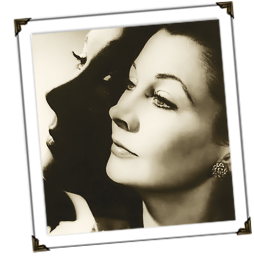
Bipolar Disorder
Trader Faukner (actor and friend about Vivien Leigh): If you upset her,
she could be a scorpion, but it was part of her personality.
She could be dangerous. She could be very, very dangerous, but also she could be
very sweet, very charming, and very warming.
Bipolar disorder, also known as manic-depressive illness, involves extreme mood
swings - from overly "high" and/or irritable to sad and hopeless, and then back again.
Severe changes in energy and behavior go along with these changes in mood. The periods
of highs and lows are called episodes of mania and depression.
Different from the normal ups and downs that everyone goes through, the symptoms
of bipolar disorder are severe. They can result in damaged relationships, poor
job or school performance, and even suicide. But there is good news:
bipolar disorder can be treated, and people with this illness can lead full
and productive lives.
Vivien Leigh: I cannot let well enough alone. I get restless. I have to be doing different
things. I am very impatient person and headstrong. If I've made up my mind
to do something, I can't be persuaded out of it.
As we know, Vivien Leigh and Laurence Olivier were married in 1940.
During the war years, Vivien with her husband worked hard on stages. Remembering
this period, stepson Tarquin Olivier, said, "She was an insomniac always,
and he had to sit up with her, and he was not an insomniac. She only needed about
three or four hours a night. It was very hard." In 1944, while filming Caesar and
Cleopatra, Vivien discovered she was pregnant, but a fall on the set caused her to
miscarry. It was Tarquin's opinion that losing that baby "caused her manic
depression to come forward" (Biography, 2000). Additionally, in 1945 she was
diagnosed with tuberculosis.
Vivien Leigh: You know the passage where Scarlett voices her happiness that her mother
is dead, so that she can't see what a bad girl Scarlett has become? Well, that's me.
Bipolar disorder was little understood at that time. Lithium was not yet in use,
and the only treatment Vivien received was shock therapy, which was not then administered
with the same level of care as today. Tarquin Olivier saw burns on his stepmother's
temples at times from her shock treatments. Vivien's ill health, physical and mental,
began to strain her marriage. Vivien was drinking heavily at times, culminating
in a breakdown during the filming of Elephant Walk
(she was replaced by Elizabeth Taylor).
Vivien Leigh: I'm never tired.
In spite of her illnesses, she continued to work in a handful of films and on stage,
winning a second Oscar for her performance in A Streetcar Named Desire. Laurence Olivier
finally divorced her in 1960 to marry an actress Joan Plowright. Though Vivien lived
for the rest of her life with an actor Jack Merivale, friends
agree that Olivier was her great love. Vivien Leigh died of tuberculosis in 1967.
Laurence Olivier (from his autobiography): Throughout her possession by that uncannily evil monster, manic depression, with its deadly ever-tightening spirals, she retained her own individual canniness – an ability to disguise her true mental condition from almost all except me, for whom she could hardly be expected to take the trouble.