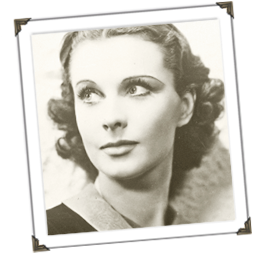
Vivien Leigh TIMELINE / January
1936: Vivien appears at the New Theatre one January afternoon to audition for her role as the Queen in Richard II
16 January 1939: the signing ceremony in the presence of Cukor, Olivia de Havilland, Leslie Howard, and Vivien Leigh.
26 January 1939: begins filming Gone with the Wind
7 January 1940: opens in Twenty-One Days
January 1945: finishes filming Caesar and Cleopatra
22 January 1948: opens in Anna Karenina (London)
21 January 1949: opens in The School for Scandal in Old Vic repertory season
26 January 1949: opens in Richard III
January 1953: Leigh travels to Ceylon to film Elephant Walk with Peter Finch.
Your generous
donations keep the site
vivien-leigh.info kleen and ad-free!
THANK YOU!
ABOUT VIVIEN LEIGH
Vivien Leigh, Lady Olivier (real name Vivian Mary Hartley)
was a legendary beauty whose film fame rests largely
on her two Oscar-winning US roles: in Gone with the Wind
(1939) and in A Streetcar Named Desire (1951).
Trained at RADA, she always claimed the stage (debut 1935)
as her first allegiance, though the jury remained divided
about her work in classical drama.
She entered films in 1935, getting her first major chance
in Fire Over England (1937), as romantic interest of future
husband Laurence Olivier, and then was vivid enough in several
late 1930s films of which the best remembered is A Yank at Oxford
(1937).
There were romantic-tragic successes in two US films - Waterloo
Bridge (1940) and That Hamilton Woman (1941)
- but her postwar British films saw her unequal to the demands
of Caesar and Cleopatra (1945), Anna Karenina (1948) and The Deep Blue Sea
(1955).
Also Vivien Leigh was a prolific stage performer, frequently in collaboration
with her husband, Laurence Olivier, who directed her in several of her roles.
She played parts that ranged from the heroines of Noel Coward and George Bernard Shaw comedies to classic
Shakespearean characters such as Ophelia, Cleopatra, Juliet and Lady Macbeth.
Lauded for her beauty, Leigh felt that it sometimes prevented her from being
taken seriously as an actress, but ill health proved to be her greatest
obstacle. Affected by bipolar disorder for most of her adult life, she gained
a reputation for being a difficult person to work with, and her career went
through periods of decline. She was further weakened by recurrent bouts of
chronic tuberculosis, with which she was first diagnosed in the mid-1940s.
She and Olivier divorced in 1960, and Leigh worked sporadically in film and
theatre until her death from tuberculosis.